The Problem With Artificial Light at Night
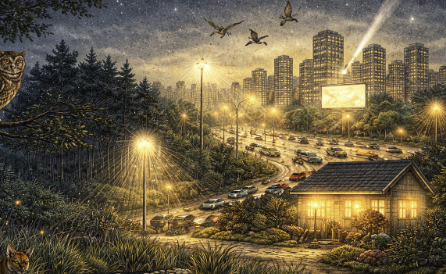
When people talk about pollution, they usually mean something visible in the air, the water, or the soil. But one of the most widespread forms of pollution is something we rarely question at all: artificial light at night. Streetlights, billboards, parking lots, office towers, and brightly lit homes have transformed darkness into a constant glow. For humans, this may look like convenience, safety, or modernity. For the environment, however, excessive nighttime lighting is a serious and growing problem.
Darkness is not empty space. It is a natural condition that many species depend on for survival. Over millions of years, animals evolved around daily cycles of light and dark. When artificial light interrupts those rhythms, it can affect feeding, migration, reproduction, and predator-prey relationships. Sea turtle hatchlings, for example, are meant to follow moonlight reflecting off the ocean, but bright coastal development can confuse them and send them inland instead. Birds that migrate at night can become disoriented by illuminated buildings and towers, leading to exhaustion or fatal collisions. Insects, especially moths and pollinators, are drawn to artificial lights, where they waste energy circling bulbs instead of feeding or reproducing.
The damage does not stop with wildlife. Plants also respond to light cues. Artificial lighting can interfere with flowering cycles, leaf drop, and seasonal dormancy. In urban and suburban areas, trees exposed to constant light may behave differently from those in darker environments, which can ripple outward to affect the insects and birds that rely on them. Entire local ecosystems can be subtly reshaped just because the night is no longer truly dark.
Light pollution also has consequences for human health. Our bodies are governed by circadian rhythms, which help regulate sleep, hormones, metabolism, and mood. Exposure to bright light at night, especially blue-rich light, can suppress melatonin production and make restful sleep harder to achieve. While city residents often accept glowing skies and harsh outdoor lighting as normal, the body does not necessarily adapt well to a world without darkness. In that sense, light pollution is not only an ecological issue but a public health issue too.
What makes this problem especially frustrating is that it is often unnecessary. Much outdoor lighting is poorly designed. Lamps shine upward into the sky instead of downward onto the ground where light is actually needed. Buildings stay illuminated long after people have gone home. Commercial signage is made brighter than required. In many cases, reducing light pollution does not mean sacrificing safety. It means using smarter lighting: shielded fixtures, warmer-colored bulbs, motion sensors, dimmers, and curfews for nonessential lighting.
Protecting darkness may sound less urgent than protecting forests or oceans, but it is deeply connected to both. A healthier night environment supports biodiversity, reduces wasted energy, lowers emissions, and helps reconnect people with the natural world. The stars disappearing above us are not just a poetic loss. They are evidence that we have changed the environment in ways we barely notice. Relearning how to light our world more carefully is a small but meaningful step toward living with greater respect for the rhythms of the planet.